CV libraries and project references that compound across bids.
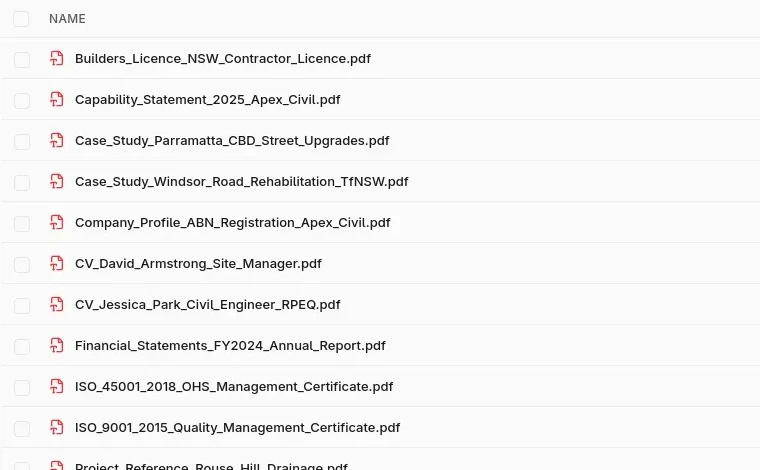
Engineering firms answer RFTs where the response IS the people and the projects. Tendor keeps CVs current, project references tagged inside the evidence library, and case studies reusable across every bid workspace — so the next bid leans on a library that already won the last one.

The shape of the work
| Metric | Pattern | Detail |
|---|---|---|
| DISCIPLINE DIVERSITY PER PURSUIT | Six to twelve disciplines named in a single RFT. | Structural, geotechnical, hydraulic, electrical, mechanical, environmental, digital — every alliance or panel reshuffles the matrix. |
| CVS PER SUBMISSION | Forty to eighty CVs, re-keyed for every response. | The same senior engineer carries a different one-pager per buyer. Half of bid prep is reformatting people who already won. |
| PROJECT REFS REUSED | Three to five flagship projects, told ten different ways. | EPC wants HSE, alliance wants delivery model, private wants schedule certainty — same project, three case studies, rewritten each time. |
| EVIDENCE ROT RATE | Quarterly drift — CPEng registrations, insurances, ISO renewals. | CPEng, regional engineering registrations, NER, PI, ISO 9001/14001/45001 — rolling calendars, expired by the next submission. The last fortnight chases certificates. |
Where Tendor changes it
Tagged CVs, project references and case studies — connected once, reused across every infrastructure, alliance, panel and private response.
A signal from the field
One tagged CV library — by discipline, registration and client.
Project refs carry outcomes, HSE and delivery model on the same record.
Sydney rail upgrade reads alliance one way, private EPC another — no retyping.
Composite scenario based on private-preview cohort patterns.
Walk an engineering pursuit with us in 30 minutes.
Bring a real RFT you're weighing — an infrastructure program, an alliance bid, a public panel, a private EPC engagement. We'll walk the CV library, project references and case studies against it, and show what compounding looks like by the third response.